Advertisement
ACCFF vs FINV


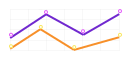
To compare these two companies we present long-term analysis, their fundamental ratings and make comparative short-term technical analysis which are presented below. The conclusion is ACCFF is a Hold and FINV is a StrongBuy.
Long-Term Analysis
It is best to consider a long-term outlook for a ticker by using Fundamental Analysis (FA) ratings. The rating of 1 to 100, where 1 is best and 100 is worst, is divided into thirds. The first third (a green rating of 1-33) indicates that the ticker is undervalued; the second third (a grey number between 34 and 66) means that the ticker is valued fairly; and the last third (red number of 67 to 100) reflects that the ticker is undervalued. We use an FA Score to show how many ratings show the ticker to be undervalued (green) or overvalued (red).
ACCFF’s FA Score shows that 1 FA rating(s) are green whileFINV’s FA Score has 1 green FA rating(s).
- ACCFF’s FA Score: 1 green, 4 red.
- FINV’s FA Score: 1 green, 4 red.
Short-Term Analysis
It is best to consider a short-term outlook for a ticker by using Technical Analysis (TA) indicators. We use Odds of Success as the percentage of outcomes which confirm successful trade signals in the past.
If the Odds of Success (the likelihood of the continuation of a trend) for each indicator are greater than 50%, then the generated signal is confirmed. A green percentage from 90% to 51% indicates that the ticker is in a bullish trend. A red percentage from 90% - 51% indicates that the ticker is in a bearish trend. All grey percentages are below 50% and are considered not to confirm the trend signal.
ACCFF’s TA Score shows that 2 TA indicator(s) are bullish while FINV’s TA Score has 4 bullish TA indicator(s).
- ACCFF’s TA Score: 2 bullish, 1 bearish.
- FINV’s TA Score: 4 bullish, 3 bearish.
Price Growth
ACCFF (@Savings Banks) experienced а 0.00% price change this week, while FINV (@Savings Banks) price change was -2.90% for the same time period.
The average weekly price growth across all stocks in the @Savings Banks industry was -1.58%. For the same industry, the average monthly price growth was -5.47%, and the average quarterly price growth was +1.21%.
Reported Earning Dates
FINV is expected to report earnings on Mar 23, 2026.
Industries' Descriptions
@Savings Banks (-1.58% weekly)A savings bank primary function is to take deposits and paying interest on those deposits. Originating in Europe during the 18th century, these banks were generally introduced to incentivize people of all stripes to save money and park them with banks. By the 1990s, the internet ushered in online savings banks that allowed savers to deposit/transact with banks digitally, without requiring to visit a branch office. Savings banks have potentially encouraged lower-income population to save and have access to a financial institution to earn interest on their money. New York Community Bancorp, Inc, Webster Financial Corporation, Washington Federal, Inc. are examples of savings banks.
| ACCFF | FINV | ACCFF / FINV | |
| Capitalization | 11.8M | 1.24B | 1% |
| EBITDA | N/A | 3.27B | - |
| Gain YTD | 0.000 | -4.015 | - |
| P/E Ratio | N/A | 3.27 | - |
| Revenue | 37.1M | 14B | 0% |
| Total Cash | N/A | 7.04B | - |
| Total Debt | 346M | 1.15B | 30% |
ACCFF | FINV | ||
|---|---|---|---|
OUTLOOK RATING 1..100 | 41 | 62 | |
VALUATION overvalued / fair valued / undervalued 1..100 | 98 Overvalued | 10 Undervalued | |
PROFIT vs RISK RATING 1..100 | 100 | 69 | |
SMR RATING 1..100 | 92 | 49 | |
PRICE GROWTH RATING 1..100 | 90 | 81 | |
P/E GROWTH RATING 1..100 | 1 | 94 | |
SEASONALITY SCORE 1..100 | 40 | 50 |
Tickeron ratings are formulated such that a rating of 1 designates the most successful stocks in a given industry, while a rating of 100 points to the least successful stocks for that industry.
FINV's Valuation (10) in the null industry is significantly better than the same rating for ACCFF (98). This means that FINV’s stock grew significantly faster than ACCFF’s over the last 12 months.
FINV's Profit vs Risk Rating (69) in the null industry is in the same range as ACCFF (100). This means that FINV’s stock grew similarly to ACCFF’s over the last 12 months.
FINV's SMR Rating (49) in the null industry is somewhat better than the same rating for ACCFF (92). This means that FINV’s stock grew somewhat faster than ACCFF’s over the last 12 months.
FINV's Price Growth Rating (81) in the null industry is in the same range as ACCFF (90). This means that FINV’s stock grew similarly to ACCFF’s over the last 12 months.
ACCFF's P/E Growth Rating (1) in the null industry is significantly better than the same rating for FINV (94). This means that ACCFF’s stock grew significantly faster than FINV’s over the last 12 months.
| ACCFF | FINV | |
|---|---|---|
| RSI ODDS (%) | N/A | N/A |
| Stochastic ODDS (%) | N/A | 2 days ago 77% |
| Momentum ODDS (%) | 3 days ago 39% | 2 days ago 69% |
| MACD ODDS (%) | 3 days ago 21% | 2 days ago 67% |
| TrendWeek ODDS (%) | 2 days ago 15% | 2 days ago 71% |
| TrendMonth ODDS (%) | 2 days ago 15% | 2 days ago 71% |
| Advances ODDS (%) | N/A | 23 days ago 80% |
| Declines ODDS (%) | N/A | 6 days ago 73% |
| BollingerBands ODDS (%) | N/A | 2 days ago 64% |
| Aroon ODDS (%) | 2 days ago 6% | 2 days ago 67% |


Advertisement
| 1 Day | |||
|---|---|---|---|
| MFs / NAME | Price $ | Chg $ | Chg % |
| MGLCX | 16.51 | 0.10 | +0.61% |
| MFS Global Real Estate C | |||
| HDAVX | 19.09 | 0.04 | +0.21% |
| Janus Henderson International Div A | |||
| LYFIX | 16.25 | 0.01 | +0.06% |
| AlphaCentric Life Sciences & Hlthcare I | |||
| PORTX | 56.81 | N/A | N/A |
| Trillium ESG Global Equity Investor | |||
| SHAPX | 35.37 | -0.20 | -0.56% |
| ClearBridge Appreciation A | |||
ACCFF and
Correlation & Price change
A.I.dvisor indicates that over the last year, ACCFF has been loosely correlated with CMPRF. These tickers have moved in lockstep 39% of the time. This A.I.-generated data suggests there is some statistical probability that if ACCFF jumps, then CMPRF could also see price increases.
| Ticker / NAME | Correlation To ACCFF | 1D Price Change % | ||
|---|---|---|---|---|
| ACCFF | 100% | N/A | ||
| CMPRF - ACCFF | 39% Loosely correlated | N/A | ||
| ALTG - ACCFF | 7% Poorly correlated | +0.15% | ||
| FINV - ACCFF | 5% Poorly correlated | -2.52% | ||
| AEOJF - ACCFF | 1% Poorly correlated | N/A | ||
| AIFLY - ACCFF | -0% Poorly correlated | N/A | ||
More | ||||
FINV and
Correlation & Price change
A.I.dvisor indicates that over the last year, FINV has been closely correlated with QFIN. These tickers have moved in lockstep 67% of the time. This A.I.-generated data suggests there is a high statistical probability that if FINV jumps, then QFIN could also see price increases.
| Ticker / NAME | Correlation To FINV | 1D Price Change % | ||
|---|---|---|---|---|
| FINV | 100% | -2.52% | ||
| QFIN - FINV | 67% Closely correlated | -2.96% | ||
| LX - FINV | 60% Loosely correlated | -3.57% | ||
| LU - FINV | 50% Loosely correlated | -1.92% | ||
| YRD - FINV | 47% Loosely correlated | -2.30% | ||
| XYF - FINV | 38% Loosely correlated | -1.90% | ||
More | ||||